
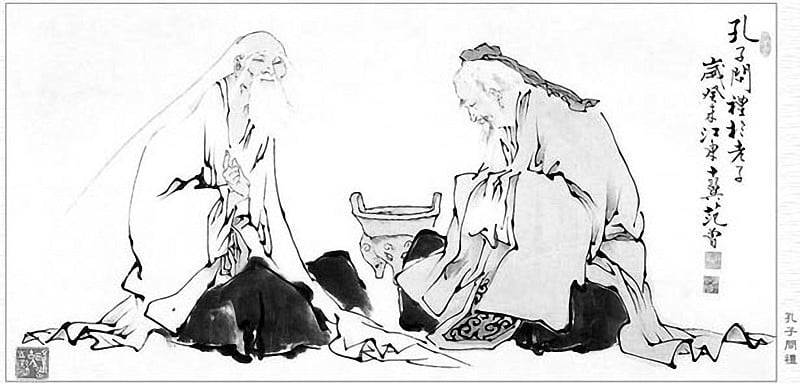
One day in 538 BC, Confucius said to his disciple Nangong Jingshu: “Lao Dan, the Archivist of the Zhou Royal Archives, is widely learned in both past and present, understands the origins of rites and music, and grasps the essence of morality. I wish to travel to Zhou to seek his teachings. Would you be willing to accompany me?” Nangong Jingshu gladly agreed and promptly reported this to the Duke of Lu. The Duke approved his journey, providing him with a carriage, two horses, a servant, and a driver, and Nangong Jingshu accompanied Confucius on his journey.
Laozi was very pleased to see Confucius coming from thousands of miles away.
He asked Confucius: “Have you attained the Dao?”
Confucius replied: “I have sought it for twenty-seven years, yet I still have not attained it.”
Laozi said: “If the Dao were a tangible thing that could be presented to others, people would compete to offer it to their sovereigns. If the Dao could be given as a gift, people would give it to their loved ones. If the Dao could be clearly stated, people would tell it to their brothers. If the Dao could be passed on, people would vie to transmit it to their children. Yet none of these is possible. The reason is simple: if a person does not have a correct understanding of the Dao in their heart, the Dao will never enter into them.”
Confucius said: “I have studied the Classic of Poetry, the Classic of History, the Rites of Zhou, the Book of Music, the I Ching, and the Spring and Autumn Annals. I lecture on the ways of governance of ancient sage-kings and deeply understand the paths of success of Duke Zhou and Duke Shao. With these, I have audience with more than seventy rulers, but none adopted my doctrines. It seems that people are truly too difficult to persuade!”
Laozi remarked: “The ‘Six Classics’ you speak of are merely the outdated history of ancient kings. What use is it to talk about them now? What you are studying today is also just old material handed down consecutively. A ‘footprint’ is merely an impression left behind by a person’s shoe; how could one footprint be fundamentally different from another?”
After their initial dialogue, Laozi led Confucius to visit Official Chang Hong. Chang Hong was exceptionally versed in music theory and taught Confucius musical temperaments and theory. He also guided Confucius to observe sacred rituals, inspect places of instruction, and observe temple ceremonies. Confucius was full of admiration and benefited immensely.
Confucius stayed in the region for several days before bidding farewell to Laozi.
Lao Dan saw him out of the guesthouse and said: “I have heard that the wealthy send people off with gifts of wealth, while the benevolent send people off with words of wisdom. I am neither wealthy nor noble, so I have no riches to give you; I wish to send you off with a few words. In today’s world, those who are clever and deeply observant face hardship and nearly meet death because they love criticizing others’ faults; those who are eloquent and discerning bring disaster upon themselves because they love exposing others’ shortcomings. As a son, do not hold yourself above others; as a minister, do not regard yourself as superior. I hope you will keep this firmly in mind.” Simply put, this means: “I have nothing material to give you, so take these words: do not defame others, do not excessively praise others, and do not be arrogant.”
Confucius replied: “Your disciple will surely keep this in his heart.”
When Confucius reached the banks of the Yellow River, he saw the rushing waters and churning muddy waves, surging forward like tens of thousands of horses galloping, roaring like tigers and thunder. Confucius stood on the riverbank for a long time and could not help lamenting: “Time passes away like this stream, never ceasing day or night! The Yellow River rushes forward without end, human years slip away unceasingly; the river knows not where it flows, and human life knows not where it returns.” Just as river water flows day and night without stopping, human life does the same, never knowing where it will ultimately end up.
Hearing Confucius’s words, Laozi said: “A person’s existence between Heaven and Earth is one with Heaven and Earth. Heaven and Earth are creations of Nature; human life is likewise a creation of Nature. Humans undergo the transformations of childhood, youth, prime, and old age, just as Heaven and Earth undergo the alternation of spring, summer, autumn, and winter. What is there to lament? Born of nature, dying in nature—let nature take its course, and your fundamental nature will not be perturbed. If you do not let nature take its course and instead run frantically amid benevolence and righteousness, your true nature will be fettered. When fame and merit reside in the heart, anxiety is born; when greed and desires linger in the mind, worries multiply.”
Confucius explained: “I grieve because the Great Dao does not prevail, benevolence and righteousness are not practiced, warfare does not cease, and state chaos is not governed. Hence I lament that life is fleeting, unable to accomplish great deeds for the world or bring well-being to the people.”
After a moment, Laozi pointed toward the vast Yellow River and asked Confucius: “Why do you not learn from the virtue of water?”
Confucius inquired in return: “What virtue does water possess?”
Laozi said: “The highest excellence is like water. Water excels at benefiting all things without contending with them, and abides in places that all men detest; this is the virtue of humility. Therefore, the reason seas and rivers can be kings of hundreds of valleys is that they excel at staying low; thus they are able to be rulers of all streams. In all the world, nothing is softer or weaker than water, yet in attacking what is firm and strong, nothing can surpass it; this is the virtue of yielding. Thus softness overcomes hardness, and weakness overcomes strength. Because it has no substance, it can enter where there is no crevice. From this, one can understand the teaching without words and the benefits of non-action (wu wei).”
Confucius had a moment of sudden enlightenment and said: “Your words have completely cleared the fog from my mind: While all men seek the heights, water alone dwells in the depths; while all men seek ease, water alone stays in danger; while all men seek purity, water alone stays in filth. It resides in places everyone dislikes—who then could contend with it? This indeed is why it represents the highest excellence.”
Laozi nodded and said: “You are truly teachable! Remember this well: If you contend not with the world, no one in the world can contend with you; this is emulating the virtue of water. Water approaches the Dao: the Dao is everywhere, and water benefits everything. It shuns heights and rushes downward, never opposing; this is excellence in choosing its ground. In stillness it is tranquil and unfathomably deep; this is excellence in heart and depth. It expends without being depleted, giving without seeking reward; this is excellence in benevolence. In a round vessel it swirls, at a square corner it bends, blocked it halts, unblocked it flows; this is excellence in keeping faith. It washes away impurities and balances high and low; this is excellence in governance. Bearing objects it floats them, reflecting light it clarifies, attacking obstacles none can match it; this is excellence in capability. Ceaseless day and night, filling hollows before moving forward; this is excellence in awaiting its time. Therefore, the sage acts according to the times, and the virtuous adapts to circumstances; the wise governs through non-action, and the enlightened lives in accord with Heaven. When you depart from here, you must eliminate arrogance from your speech and purge ambition and desires from your countenance. Otherwise, your fame will precede your arrival and the wind will stir before your presence—flaunting yourself like a tiger walking down a bustling street, who would dare employ you?”
Confucius said: “Master’s words come from the depths of your heart and have entered into my very soul. I have benefited immensely and will never forget them for the rest of my life. I shall abide by them diligently to repay your kindness.” With that, he bade farewell to Laozi, boarded the carriage with Nangong Jingshu, and departed reluctantly toward the State of Lu.
After returning from Laozi, Confucius did not speak for three days. Zigong asked in perplexity what had happened. Confucius replied: “If I encounter someone whose thoughts soar like a flying bird, I can use my arguments like sharp, precise arrows to shoot down and subdue them. If their thoughts gallop unbound like a wild deer, I can unleash hounds to chase them down until subdued by my reasoning. If their thoughts swim in the deep abyss of theory like a fish, I can catch them with a hook. But if their thoughts are like a dragon—riding clouds and mist, roaming in the boundless ethereal realm, formless and unpredictable—I have no way to pursue or capture it. When I met Laozi, I felt his realm of thought was like a dragon soaring in the infinite void. It left my mouth agape without words, my tongue out unable to retract, leaving me unsettled, wondering whether he was mortal or divine. Lao Dan is truly my master!”
Support Independent Perspectives & In-Depth Insights
Every thoughtful analysis and candid critique comes from our dedication to truth and quality. We choose not to follow sensational algorithms or clickbait headlines.
Sustaining independent research requires reader support. Make a one-time or monthly contribution, securely processed by Google.
Payments secured by Google · Manage or cancel anytime in your Google Account




Comments