
A man claiming to be the chairman of a political party recently made the news. Although most people were far more fascinated by the handsome young police officer on the scene, this party chairman claimed he went undercover under an assumed identity at President Chain Store (7-Eleven), enduring months of hardship as an undercover worker on behalf of the public interest just to catch the convenience store violating the Labor Standards Act. So today, let’s look into the legal articles cited by the chairman and the subsequent legal clarifications provided by the Department of Labor.
This time, the party chairman cited Article 36 of the Labor Standards Act, which stipulates that “a worker shall have at least one day of rest every seven days as a regular day off.” Based on this, he unilaterally declared his resignation mid-shift and abandoned his post.
However, just as the chairman was gleefully publicizing the fruits of his undercover operation to the press, the Taipei City Department of Labor dealt him a sobering blow.
The Department of Labor stated that Article 36 simply requires one rest day within any given seven-day period. Therefore, as long as there is one day off at the very beginning and one at the very end, an employee can legally work up to 12 consecutive days in between, and doing so is not against the law.
So, we have specially designed a work calendar for all our dear bosses (see diagram below). The red circles indicate the key points: as long as bosses follow this schedule to decide how to squeeze their employees—er, provide employee benefits—giving your staff only three days off in a month will keep you completely clear of trouble.
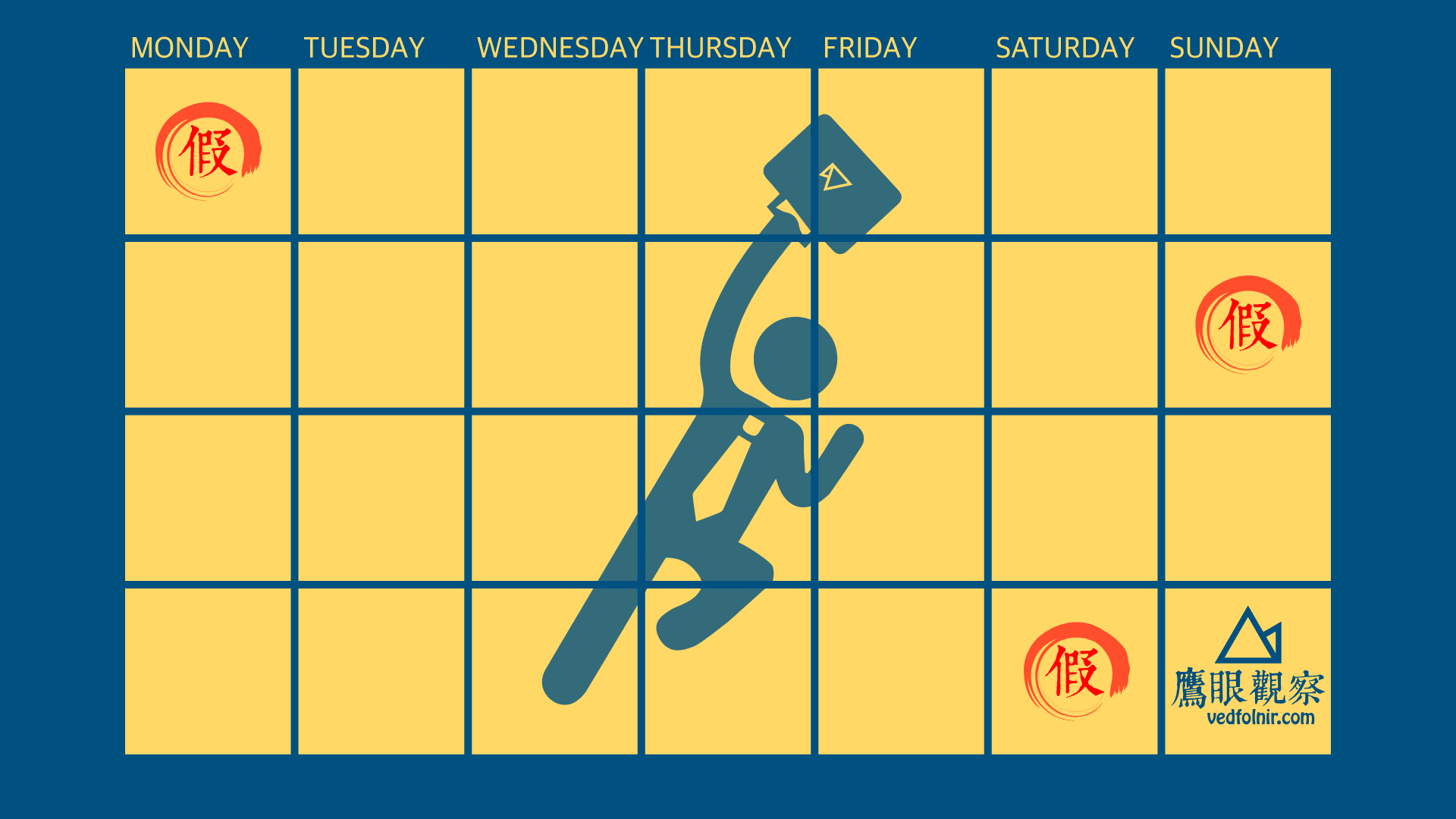 The art of leave arrangement for squeezing employees.
Boss, did you think that was the end of it? Our employee-exploitation skills are premier in the industry!
Boss, don’t look at the calendar above and think giving three days off is generous. That only happened because the very first day started with a day off. When it rolls into the next month and the month after that, you actually only need to give your employees two days off per month. Isn’t that fantastic?
 Scheduling leave from January to April for your employees.
This is the first trick we have to teach all our dear bosses on how to squeeze staff. As for the other 49 closely guarded secrets, please stay tuned for our forthcoming paid e-book (ha!).
Wait, what about the party chairman misinterpreting the law and abandoning his post mid-shift? Well, the chairman should really thank that handsome young police officer for deflecting public attention.
Some cited Supreme Administrative Court Ruling No. 2199 of Year 90 (2001), stating: “Upon review, the mandate that workers shall have at least one day of rest every seven days as a regular day off under Article 36 of the Labor Standards Act is a compulsory statutory requirement and cannot be altered arbitrarily by contract. Even if an agreement existed between the plaintiff and Mr. Shi to take regular leave only after working twelve consecutive days, such agreement is invalid due to violating mandatory legal provisions…” Based on this, some argued the Department of Labor’s interpretation was erroneous.
BUT, can a 15-year-old precedent still be applied directly under current regulations? In truth, while the statutory wording itself hasn’t changed drastically, official interpretations and enforcement guidelines certainly have.
In earlier years, a seven-day cycle was strictly viewed as a standalone unit within which at least one rest day had to be scheduled—aligning with what common sense would expect.
However, in 2003 (Republic of China Year 92), the Executive Yuan broadened the flexible working hours framework to apply to general labor (Letter Lao-Dong-2-Zi No. 0920018071, March 31, 2003). The objective was to enable fragmented work hours to be consolidated and to resolve scheduling dilemmas faced by enterprises, thus introducing 2-week, 8-week, and 4-week flexible working hour schemes.
Consequently, alongside Article 36 and Article 30 (which stipulates normal work hours shall not exceed 8 hours per day and 40 hours per week, with total weekly hours not exceeding 48), Article 30-1 explicitly provides:
“For industries designated by the central competent authority, an employer may, with the consent of the labor union, or if no union exists, through approval by a labor-management conference, alter working hours according to the following principles: 1. Normal daily working hours allocated to other working days within a four-week period shall not exceed two hours per day, exempt from paragraphs 2 to 4 of the preceding article. 2. When normal working hours on a given day reach ten hours, overtime shall not exceed two hours. 3. There shall be at least two days of rest as regular days off within every two weeks, exempt from the restrictions of Article 36. 4. Female workers, except during pregnancy or nursing, may work night shifts without being subject to Article 49, Paragraph 1, provided the employer offers necessary safety and sanitation facilities.”
Seeing this, you’ve probably figured it out! Yes, folks, you guessed right! Convenience stores (wholesale and retail trades) happen to qualify under Article 30-1, Paragraph 3 [1], meaning they only need to provide two regular rest days every two weeks (Order Lao-Dong-2-Zi No. 0920056353, October 8, 2003).
What a wonderful world—exclusively for bosses.
Having taken a detour through the legal intricacies, if you ask for my personal view: although I am the type who wishes for endless holidays, takes every available leave, and would even take personal unpaid leave just to stay home (just kidding), I still suggest 7-Eleven hold the party chairman accountable for abandoning the premises and leaving the store in a vulnerable state.
Some netizens might label this as having an employee mindset, but if one accepts employment, one ought to balance personal rights while considering company security and responsibility.
If I were to take such an action, I would submit my resignation before my shift started rather than walking away midway through performing duties.
Abandoning one’s post during business hours is irresponsible toward both the employer and oneself, and leaves the store in grave jeopardy—even if the chairman intended from the start to make a grand public spectacle to elevate the issue (not to mention the chairman himself had the legal facts wrong).
Reader Q&A
Can two-week flexible working hour cycles overlap or borrow days across periods? (Reader Huan-Yue)
Correction from Reader Huan-Yue:
While two weeks require two days off, consecutive cycles cannot overlap! Although your chart is satirical, four weeks in the first month must legally have four regular days off; having only three is unlawful.
Bigman’s Gratitude and Analysis:
Thank you very much to our reader for the astute and professional legal correction!
Under the two-week flexible working hours scheme of Article 30-1 of the Labor Standards Act, scheduling intervals must be “consecutive, fixed, non-overlapping 14-day” independent cycles. Employers can never flexibly overlap cycles or shift monthly cycles at will; therefore, within four consecutive weeks, there must legally be at least four full days off!
The reason we deliberately drew that absurd schedule was precisely to satirize and expose the deceptive scheduling tricks often played by unscrupulous bosses—using overlapping cycle calculations across months to shift rest days from an earlier cycle into a later one, forcing employees to work continuously while surreptitiously losing a day off. When reviewing your own duty schedules, always remember the golden rule of “independent, non-overlapping cycles”—never let your hard-earned leave be stolen by management’s numbers game!
Appendix
- Occupations designated under Article 30-1, Paragraph 3 of the Labor Standards Act include: manufacturing, construction, tour bus transport, air transport, harbor services, postal services, telecommunications, real estate investment and development, wholesale and retail trades, photocopying, auto detailing, electrical and electronic appliance repair, motorcycle repair, other unclassified item repair services, laundry services, photographic processing, bathhouse services, tailoring, other specialized scientific and technical services, consulting services, software publishing, agriculture, forestry, fishery and animal husbandry, leasing and rental services, tap water supply, and industries operating according to the administrative office calendar of government agencies.
Support Independent Perspectives & In-Depth Insights
Every thoughtful analysis and candid critique comes from our dedication to truth and quality. We choose not to follow sensational algorithms or clickbait headlines.
Sustaining independent research requires reader support. Make a one-time or monthly contribution, securely processed by Google.
Payments secured by Google · Manage or cancel anytime in your Google Account




Comments