
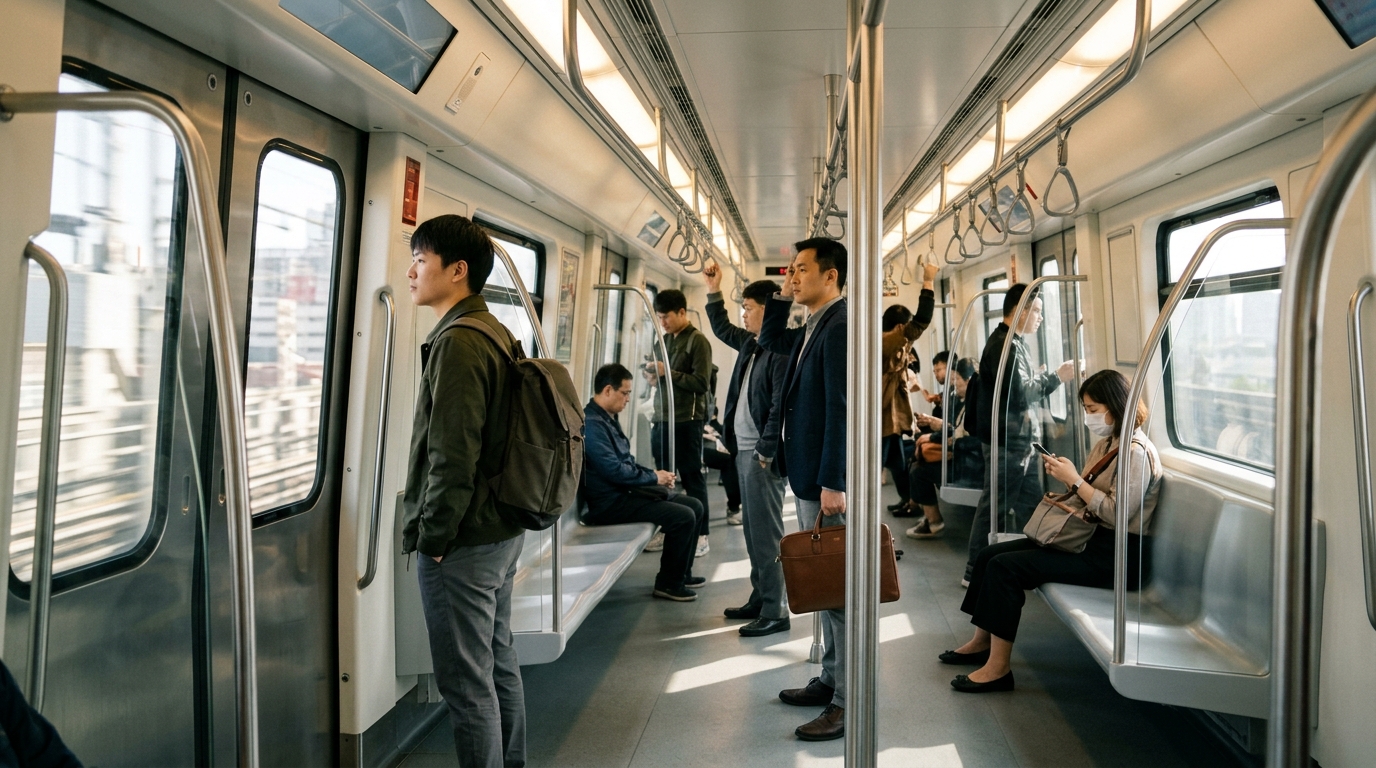
Recently, that familiar refrain has surfaced once again across social feeds: passengers riding the metro must wear their backpacks across their chests or place them down on the floor, accompanied by the smug reminder that “this is true civic consideration and transit etiquette.”
Naturally, a chorus of uncritical agreement followed, chanting: “In Japan, everyone does this on commuter trains,” and “Japan is the pinnacle of civilized society, while Taiwan lags light-years behind in civic manners.”
Whenever I encounter this sort of decontextualized moral coercion—treating the peculiar customs of a single nation as sacred gospel—I can only ask: Has our understanding of modern public governance and daily living truly deteriorated to the point where “Japan’s way is the only right way”?
1. Only Japan Does This: The Absurdity of Projecting a Local Anomaly as Universal
Look across major rapid transit networks worldwide—the London Underground (the Tube), the New York Subway (MTA), the Paris Métro, the Seoul Subway, the Berlin U-Bahn, and Singapore’s MRT. Which of these world-class transit systems elevates “mandatory chest-carrying of backpacks” into a moral litmus test for all passengers?
In North America, Europe, and most developed societies, baggage awareness comes down to one simple common-sense principle: do not block walkways, and be mindful of people around you when turning. Passengers carry their bags naturally—on their backs, by hand, between their feet, or leaning against walls away from foot traffic. Out of hundreds of modern societies operating dense rail transit networks, only Japan has developed such an excruciatingly regimented code. This is not a “globally acknowledged standard of civilization”; it is a localized anomaly born out of extreme peer surveillance and conformity pressure (dōchō atsuryoku).
Taking an isolated exception and rebranding it as universal civilized behavior while denigrating one’s fellow citizens as “hopelessly uncivilized” is fundamentally a lazy, insecure cultural cringe.
2. Demanding Heavy Payloads Match Ultra-Thin Commuter Bags Violates Biomechanics
Those who casually point to Japanese salarymen as an absolute model fail to understand the evolution of Japanese commuter bags.
Traditional Japanese corporate culture prioritized handheld briefcases. Even as the “business backpack” (business rucksack) gained ground in recent years, mainstream products have remained ultra-thin rectangular designs with a depth under ten centimeters. These bags feature compact interiors, hug the wearer’s torso tightly, and take up very little volume when held in front. They are highly specialized tools engineered for a specific commuter culture.
Demanding that everyday commuters carrying heavy payloads conform to this thin-bag standard is detached from physical reality. Students carry heavy textbooks; professionals haul laptops and technical gear. Backpacks routinely weigh several kilograms—in my case, often eight to nine kilograms. On a swaying train carriage, taking off a heavy pack, twisting around, and hoisting it onto one’s chest poses an immediate hazard to oneself and nearby passengers. Furthermore, bearing that weight on the front severely violates ergonomic principles: it compresses the chest, forces cervical and upper-back compensation, and risks acute muscle strain.
When spine and skeletal health are on the line, why should anyone sacrifice physical wellbeing merely to satisfy a bystander’s moral squeamishness?
3. Framing Survival Tactics as “Elegance” Masks Governance Inaction
The historical reason Japanese railways encourage chest-carrying or hand-carrying is not elevated moral virtue—it is train occupancy rates regularly surging past 150% to 180% into extreme crush capacity. It is a desperate coping mechanism for scenarios where station staff physically shove passengers into carriages like sardines in a tin. Under that extreme density, where faces are literally pressed against carriage glass, a bag on one’s back risks ramming directly into the face of whoever is behind. Folding one’s arms around a bag in front is purely an act of spatial triage.
When an advanced society faces spatial congestion and passenger flow challenges, its responsibility is to devise rational engineering and hardware solutions based on authentic operational needs:
- Shortening peak headway intervals to the physical minimum.
- Redesigning train interior ergonomics and circulation zones.
- Installing overhead luggage racks (amidan) as standard equipment throughout all carriages—just as JR and subway systems in Japan have done for decades—so passengers have a designated physical repository to free up floor space.
Mass transit systems that lack overhead racks and decline to optimize peak carriage circulation end up letting the public convert structural and infrastructure shortcomings into horizontal “moral witch-hunts”—as if holding one’s breath and hugging a bag against one’s chest could magically expand the interior volume of a train car.
4. When Means Become Holy, Only Moral Exhibitionism Remains
The authentic intent behind railway educational campaigns has never been dogmatic chest-carrying; it has always been: “Ensure your personal belongings do not obstruct aisles or crowd others’ standing room.”
Wearing a pack on the front is merely one possible tactic. Lowering it down to one’s side by hand, placing it between one’s feet, setting it on a luggage rack, or stepping into an out-of-the-way corner are equally valid approaches. If a passenger carries an oversized mountaineering or multi-day travel pack, turning it to the chest doubles their anterior profile, completely blocks aisles, obstructs forward sightlines, and accomplishes nothing.
True civic maturity in public transit lies in situational spatial awareness—knowing how to tuck in when crowds surge, avoiding high-traffic doorway pinch points, and remaining conscious of turning radiuses. If someone is securely standing in an unoccupied corner without hindering a single passenger, how does a backpack worn on their back inconvenience anyone?
The true essence of transit etiquette is mutual consideration and reducing friction. When people elevate an idiosyncratic tactic into an absolute moral yardstick to police others, it ceases to be public etiquette—it degenerates into a cheap performance of social superiority and control.
5. Back to Common Sense: Contextual Awareness Over Rigid Dogma
Genuine civic dignity never requires subservience to imported dogmas, nor does it require citizens to belittle their own society.
Every rapid transit network operates within its own local demographic context. In day-to-day operations across metro lines in Taiwan, the overwhelming majority of operating hours do not reach the catastrophic crush loads seen in Tokyo’s metropolitan core. Demanding that every single passenger, regardless of carriage density, payload weight, or standing location, rigidly wear their bag on the chest or place it onto a dirty floor is nothing more than lazy, ritualized compliance.
What our public spaces require is not louder moralizing, but individual situational competence:
- Adapt dynamically to crowd density: Wear bags comfortably when carriages are spacious; tuck in and mind turning margins when crowds pack in.
- Select posture based on luggage profile and physical capacity: Lightweight slim packs can easily be shifted forward; heavy equipment bags can be handheld at floor level or stabilized against carriage bulkheads.
- Respect physical boundaries and bodily ergonomics: Never impose biomechanically hazardous burdens onto fellow riders, and refrain from judging neighbors from self-righteous moral heights.
Only when a society sheds the reflexive cringe of “Japan knows best” and squarely addresses its own hardware constraints, transit habits, and ergonomic realities can we foster a mature, considerate, and genuinely comfortable civic environment.
Support Independent Perspectives & In-Depth Insights
Every thoughtful analysis and candid critique comes from our dedication to truth and quality. We choose not to follow sensational algorithms or clickbait headlines.
Sustaining independent research requires reader support. Make a one-time or monthly contribution, securely processed by Google.
Payments secured by Google · Manage or cancel anytime in your Google Account



Comments