
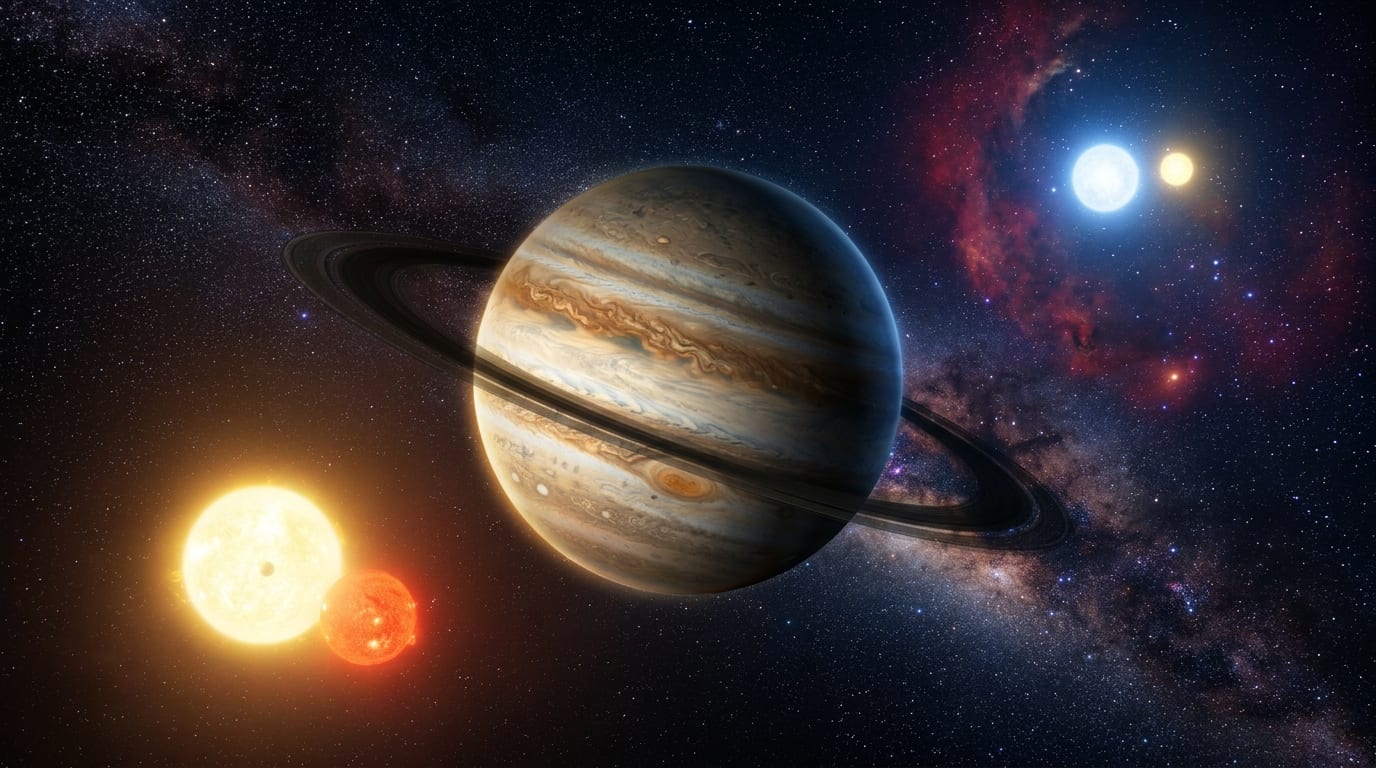
Throughout astronomical history, binary star systems have remained among the most mesmerizing cosmic phenomena. The iconic twin sunset sinking below the horizon of Luke Skywalker’s homeworld, Tatooine, in Star Wars inspired generations to imagine alien skies. In the real universe, astronomers have systematically confirmed the existence of circumbinary planets orbiting pairs of stars.
Yet what if a planet’s sky harbored four suns at once?
The astronomical community formally confirmed an exoplanet designated "**PH1**" (full name Planet Hunters 1, officially cataloged by NASA as Kepler-64b). It represents the very first planet in human observational history confirmed to reside inside a quadruple star system. This remarkable discovery not only turned science fiction into reality, but fundamentally challenged conventional astrophysics models regarding planetary formation and long-term orbital stability.
What Is PH1? A Gas Giant Basking in the Glow of Four Stars
PH1 lies approximately 5,000 light-years from Earth in the constellation Cygnus. In terms of physical characteristics, it is a gas giant intermediate in size between Neptune and Saturn:
- Planetary Radius: Approximately 6.2 times that of Earth (slightly larger than Neptune).
- Planetary Mass: Roughly 0.5 times Jupiter’s mass (between 20 and 50 Earth masses).
- Orbital Period: Orbits its central stellar pair once every 138.5 days.
- Surface Environment: Because it orbits relatively close to its two luminous host stars, its equilibrium temperature is estimated at 250°C to 480°C—far too scorching to permit liquid water or habitable conditions.
What truly astonished astronomers worldwide was not PH1’s physical scale, but the extraordinary quadruple stellar gravitational field it inhabits.
The Intricate, Harmonious Orbital Architecture of a Quadruple System
In celestial mechanics, the three-body problem already exhibits extreme chaos and unpredictability—let alone a dynamic system comprising five bodies (four stars and one planet). How does PH1 manage to maintain a stable orbit while subjected to the gravitational tug-of-war of four suns?
Scientists deconstructed the hierarchical architecture into two pairs of binaries:
| System Component | Celestial Classification | Orbital Characteristics and Dynamics |
|---|---|---|
| Inner Core Binary (Aa and Ab) | A yellow-white dwarf (~1.5 solar masses) + a red dwarf (~0.4 solar masses) | The pair orbit extremely close to one another with an orbital period of just 20 days. |
| Central Planet PH1 (Kepler-64b) | Gas giant | Stable circumbinary orbit around the inner binary core with a period of 138.5 days. |
| Outer Distant Binary (Ba and Bb) | A secondary tight binary pair | Located roughly 1,000 Astronomical Units (AU) away (1,000 times the Earth-Sun distance), orbiting the common barycenter of the entire system. |
This means that if you were standing at the outer edge of PH1’s atmosphere looking upward:
- Directly ahead, two luminous suns (a brilliant yellow-white star and a dimmer red dwarf) would pirouette around each other and eclipse one another every 20 days.
- Looking toward the deep expanse of the night sky, another brilliant binary pair would beam down like perpetual cosmic spotlights, casting a cold, enduring glow.
Under such skies, true darkness would be exceedingly rare, as the planet’s hemispheres take turns receiving light from different stars across the eons.
A Triumph of Citizen Science: The Planet Hunters Initiative
This historic breakthrough was not produced exclusively by supercomputers or tenured university professors; it stands as a celebrated hallmark of global citizen science.
1. Human Eyes Surpassing Computer Algorithms
NASA’s Kepler Space Telescope observed deep space continuously, monitoring minuscule fluctuations in brightness across more than 150,000 stars via the transit method. When an orbiting planet crosses in front of its parent star, it obstructs an infinitesimal fraction of light, producing a subtle dip in the stellar light curve.
However, in binary star systems, the stars periodically eclipse each other (eclipsing binaries), producing massive, erratic brightness variations. Conventional automated algorithms frequently dismiss the tiny transit dips caused by planets in these systems as background noise.
2. The Keen Intuition of Two Amateur Astronomers
Yale University established the Planet Hunters platform (under the Zooniverse project), opening Kepler’s massive datasets to the public for crowdsourced visual inspection. Two amateur astronomy enthusiasts—Kian Jek of San Francisco and Robert Gagliano of Arizona—spotted faint, periodic transit dips hidden beneath the complex light curves of Kepler-64.
After they flagged the anomalous signal to the Yale astronomical team, astronomers enlisted the world-class W. M. Keck Observatory atop Mauna Kea in Hawaii for high-resolution spectroscopic validation. They confirmed the planet’s reality and named it "**PH1**" to honor the invaluable contribution of citizen scientists worldwide.
Overturning Assumptions: Implications for Planetary Evolution in Extreme Environments
Under classical accretion theories, asymmetric gravitational perturbations severely disrupt the coalescence of protoplanetary dust grains. When a region is subject to the turbulent tidal forces of multiple orbiting stars, material within the protoplanetary disk should collide at destructive velocities or get ejected into interstellar space long before coalescing into a planet.
"**The discovery of PH1 proves that nature's ingenuity far exceeds the assumptions of theoretical models.**"
It confronted modern astrophysicists with brand-new questions:
- How does a protoplanetary disk manage to cool and coalesce under severe dynamic perturbations?
- How do planetary orbital resonances sustain delicate, long-term equilibrium across billions of years within multi-star gravitational environments?
As data from Kepler and the James Webb Space Telescope (JWST) continue to expand our horizons, the cosmos repeatedly dismantles provincial assumptions formed around our own Solar System. PH1 is not merely a curious celestial oddity five thousand light-years away; it is a testament to human curiosity, collective intelligence, and the relentless pursuit of scientific truth.
Support Independent Perspectives & In-Depth Insights
Every thoughtful analysis and candid critique comes from our dedication to truth and quality. We choose not to follow sensational algorithms or clickbait headlines.
Sustaining independent research requires reader support. Make a one-time or monthly contribution, securely processed by Google.
Payments secured by Google · Manage or cancel anytime in your Google Account



Comments